



| Argolis (Tau Ceti IV) | |
|---|---|
 The surface of Tau Ceti IV viewed from orbit. The surface of Tau Ceti IV viewed from orbit.
| |
| Astrographical | |
|
Star, position: |
Tau Ceti, 3rd orbital |
| Physical | |
|
Diameter: |
72,535.7808 km |
|
Gravity: |
1.03 g |
|
Orbital period: |
642.13700343 days |
| Societal | |
|
New Cascadian | |
|
Species: |
|
|
Population: |
Colony Era - ~30,000 (human) |
|
Government: |
Democratic corporatocracy |
- "Colonizing an exoplanet was never gonna be easy, but Tau Ceti... Maybe it's more than we can handle. Maybe it doesn't want us here."
- — Clarissa Song
Argolis, most commonly referred to as Tau Ceti IV, is a planet in the Tau Ceti system, twelve light years away from Sol, and the third planet colonized by humanity.[1] In 2787, New Cascadia was established by humanity, using the UESC Marathon. Conditions on the planet were initially very hospitable to humans, but after a few months many of its natural systems seemed to collectively turn against the colonists.[2]
The colony repulsed an attack by the Pfhor fighter Sfiera in 2794, but was partially destroyed in a following Pfhor attack that year.[3] Further issues from the outbreak of a novel contagion and the eruption of the alien Anomaly from beneath the surface of the planet led to the downfall of the colony.[4]
The loss of communications between New Cascadia and the Sol system was realized by the UESC by 2795,[5] and in 2797 they sent the UESC Equanimity under Project Goliath to investigate the status of the colony.[6] The Equanimity arrived in 2893, deploying ARS, UESC-aligned forces (including UESC-aligned Runners), and independent mercenary Runners serving Earth-based factions to salvage what remained of the colonization effort.[4]
Overview

Astronomical features
Tau Ceti IV is the third planet orbiting the star Tau Ceti. Its orbital period is 642.13700343 days. It has an equatorial circumference of 72,535.7808 kilometers, with a mass greater than or equal to 3.93 M•. Its surface gravity was 1.03 g.[7] It orbits within an anomalous gap in the system's debris disk. As a result the planet was at low risk of impact events which posed a risk to civilization at the time of its colonization. When the Marathon arrived in the system, its environmental satellites detected a likelihood of only two continental impact events within the next century.[8]
Environmental features
The surface of Tau Ceti IV was similar to that of Earth, with familiar features like water, plants, animals, Earth-like gravity, and an oxygen-rich atmosphere, all noted as reasons for its colonization.[9] Its surface pressure was 200.6235 KPa at sea level.[7] It had a temperate climate with a humid, warm-summer subtype. Environmental satellites deployed when the Marathon arrived in the Tau Ceti system detected no high priority mineral resources, no volcanic activity, low risk of droughts, moderate risk of flooding, low risk of extreme weather (with seasonable storms comparable to non-cataclysmic Earth weather).[8]
Locations
- New Cascadia
- Tau Ceti IV low orbit[14]

Ecology
Before New Cascadia was established, drone operators performed essential ecological surveys of Tau Ceti IV. These surveys showed that, compared to Earth, Tau Ceti IV had relatively low megafauna populations, with little diversity. Early scans showed no land mammals, though a few amphibious specimens resembled monotremes. The surveys also showed that the planet had no organisms capable of scavenging human waste or discarded food, and urged for establishing waste treatment facilities to curb the ecological impact of human presence. The release of reanimated specimens from the Marathon's biostock was prohibited until New Cascadia reached sustainable conditions for megafauna.[15]
During colony expansion in Perimeter, invasive Earth plants were observed growing naturally outside of controlled environments. Some colonists expressed concern about ecosystem disruption, but the representative botanist explained that the Exoplanet Seed Vault was curated with organisms that were as compatible with Tau Ceti IV as possible, and posed a low risk of displacing native life.[16]

In 2893, NuCaloric AI Gaius noted that a novel contagion present on the planet caused rapid rates of mutation in native organisms, with genomic changes noticeable in months, rather than decades or centuries as observed on Earth. It was further noted that the contagion's effect on Earth organisms was wildly varied.[17] After sampling both inert and active samples of the contagion, the AI determined that "mosaic spores", part of the contagion's genomic makeup, were a reproductive vector for at least 4 distinct fungal species native to Tau Ceti IV and allowed transfer of genetic material across species.[18]
Flora
The flora of Tau Ceti IV featured a mix of native species, Earth transplants/invasives, and bio-synthetic organisms. These included Sparkleaf, the Tarax plant, and poison plants that exploded in close proximity to Runners, releasing a toxic cloud.
During the Colony Era, toxic pollen regularly accumulated on the blades of TOI AP Flex V7 drones doing low-altitude sweeps over potential agricultural sites.[19]. Vehicles left outside near Perimeter quickly had their engine compartments infested with mold from airborne spores, affecting both mechanical and electrical systems in the vehicles.[20]
A local species of bonsai-like tree was genetically modified to be easier to care for and given to colonists as a morale-boosting initiative. A tea brewed from its leaves was said to have effects similar to caffeine.[21]
Other recorded species included yellow-pink flowers with gills which could be used to sweeten dishes, yellow fungi which caused hallucinations after 5-9 days of consumption, flatberries which grew under tree roots and could be used for hydration, and bitterstars which could be used as a stimulant.[22]
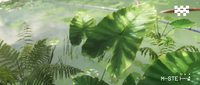 A plant species similar to Taro found in Dire Marsh.
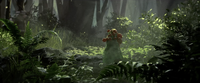 A poison plant with similar nodules to those found on Tick nests.
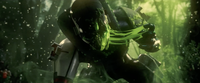 A Triage shell suffering the effects of the poison plant.


Fauna
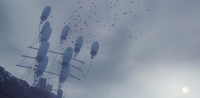
The planet's fauna included a species of mega-arthropod, the tick, many birds, including the vulture-like skrac and small flocking birds, monotremes such as a six-legged mole, amphibians such as frogs, and plentiful arthropods, such as the astacid, giant hissing beetles, dragonflies, and many species of Lepidoptera.[22] Agricultural water filters were sometimes clogged by nesting filament worms, which were impossible to eradicate using pesticides, targeted genome disruption, or nanotech.[23] Other species included the oviparous scaledove[22] and organisms known as chockisens, which occasionally harassed New Cascadia colonists.[24]
 Dragonfly
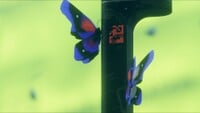 Butterflies
 Small birds


History
- "Everything was fine just a few months ago, and now it's like everything here's trying to kill us."
- — Post-colony survivor[25]

Pre-Expedition
During exoplanet candidate selection for the Marathon expedition, a joint panel of UESC physicists and NuCaloric agronomist observed that Tau Ceti IV met habitability criteria in at least one major landmass, had atmospheric readings that showed abundant carbon-based plant life, and likely required no long-term terraforming to be agriculturally self-sustaining. It was for these reasons that the planet was approved as the target candidate.[1]
Colony Era
 This section is a stub. You can help CyberAcme by expanding it.
Arrival
In 2773 the UESC Marathon arrived in the Tau Ceti system and began colonization efforts on the planet.[26] Specialists were the first people woken from cryo, before civilian colonists, based on immediate needs.[27]
By 2775, the Marathon had completed two years of orbital study of Tau Ceti IV, mapping its weather, seasons, tides, and local environments to select the best colonization sites.[28] During this two year period, probes were launched to gather soil, water, and air samples, as well as flora, fauna, and mineral samples. After this two year period, the Marathon, with the aid of Arthur, was locked into a geosynchronous orbit above the chosen colony site. Automated pre-fabricated structures were deployed to the surface, mapping potential farmlands, identifying sources of essential resources, and damming or deepening rivers based on the needs of the soon-to-be-established colony.[7]
Bastion was the first AI deployed to the planet's surface at Javelin, "the seed from which the rest of the colony will grow". Darius and Naraah were then relocated to Anchor and Abyss. Arthur and Gabriel were then transferred to Hearth, which would become the Central Living Complex. Lilith and Joy remained aboard the Marathon to assist with colonist wake cycling over a period of many years.[7]
In 2777, the first wave of citizen colonists were awakened from cryo to begin study and preparation for colonization efforts.[7]
In 2779, the first wave of colonists arrived planetside.[7] Marathon scientists were amazed to find clean water, flourishing plants, and fearless animals—a garden world with more than ideal conditions for human habitation.[29] Dr. Clarissa Song was one of the first colonists to step foot in Dire Marsh.[30]
By 2787, New Cascadia had been formally established.[26]

Contact event
In 2794, the Marathon came under attack by elements of the Pfhor Empire. The initial attack was repulsed by ten Battleroids implied to be hidden by MIDA, but later both the Marathon and New Cascadia would be subjected to heavy orbital bombardment in what would come to be known as the contact event.[31]
Novel contagion
In 2812[32] a novel contagion appeared in colony bio-research and food facilities, particularly algae ponds used for protein cultivation, before spreading to other facilities.[33] It eventually infected colonists, causing illness and death.[32]
The Anomaly
In 2827[32] the Anomaly erupted from the surface of the planet, causing significant disruption to colonization efforts due to its unpredictable effects on physics, biology, and technology (including AI systems).
Post-Colony Era
Runner Operations
- This section is a stub. You can help CyberAcme by expanding it.
Production notes
- Tau Ceti IV has a real-life counterpart in the Tau Ceti system, as two super-Earths were detected in 2017 that are located in the inner and outer edges of the system's habitable zone.[34]
Gallery
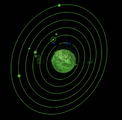 A digital render of the Tau Ceti system.
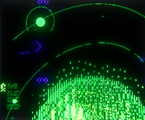 A digital close-up of Tau Ceti IV.
 A hurricane raging across the surface of Tau Ceti IV.
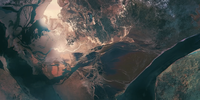 Another view of Tau Ceti IV's surface, including floodplains.
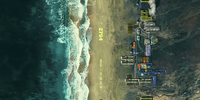 The date shown in the Reveal Cinematic Short when the attack on the Marathon is depicted.
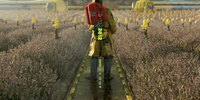 The date shown in the Cinematic Short when the novel contagion is depicted.
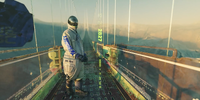 The date shown in the Cinematic Short when the The Anomaly is depicted.
 A desert on Tau Ceti IV.
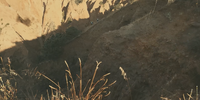 Runners traversing an arid region of Tau Ceti IV.
 A field on Tau Ceti IV.
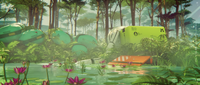 Dire Marsh, a zone on Tau Ceti IV.
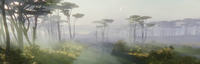 The wilderness outside Dire Marsh.
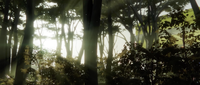 The dense flora of Dire Marsh.
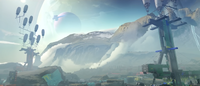 A mountain range near Perimeter on Tau Ceti IV.
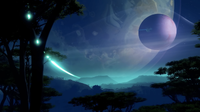 Dire Marsh at night.


Classic
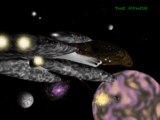 The Sfiera destroying the shuttle Mirata in orbit around Tau Ceti IV during the contact event, from Marathon (1994).
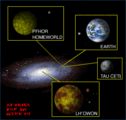 Tau Ceti IV displayed alongside the other main planets in the franchise, from Marathon 2: Durandal.


Concept Art
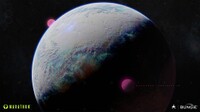 Early concept art of Tau Ceti IV.
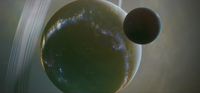 Another early concept of Tau Ceti IV.
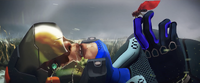 Concept art of a dead Runner and a Tau Ceti insect.


List of appearances
- This section is a stub. You can help CyberAcme by expanding it.
- Marathon (1994) (First appearance)
- Marathon (2026)
References
- ^ a b Marathon (2026), Codex, Survey Drone Cartridge: EXOPLANET CANDIDATES
- ^ Marathon (2026), Codex, Drinkable Cheeseburger: SUBSISTENCE NOTES
- ^ Marathon (1994), The Lost Network Packets
- ^ a b Marathon (2026)
- ^ Marathon (2025) ARG, Memorandum for the Secretary-General Draft A
- ^ Marathon (2025) ARG, Letter from Bethany R Montenegro-Sankara
- ^ a b c d e f Marathon (2026), Codex, UESC Marathon Model, TAU CETI IV COLONIZATION
- ^ a b Marathon (2026), Codex, Survey Drone Cartridge: REPORT FROM ORBITAL SATELLITES
- ^ Exoplanet Colonization | Marathon
- ^ Marathon (2026), Codex, Dire Marsh: Initiation
- ^ Marathon (2026), Codex, Perimeter: Initiation
- ^ a b c Marathon (2026), Codex, UESC Marathon Model, TAU CETI IV COLONIZATION
- ^ Marathon (2026), Codex, Welcome Package, WELCOME MESSAGE: STRAUSS
- ^ Marathon (2026), Codex, Cryo Archive: Initiation
- ^ Marathon (2026), Codex, Survey Drone Cartridge: ECOLOGICAL BEST PRACTICES
- ^ Marathon (2026), Codex, Shrink-Wrapped Bonsai Tree: RECORDED TOWN HALL.
- ^ Marathon (2026), Contracts: NuCaloric, Selection Pressures
- ^ Marathon (2026), Codex, Selection Pressures [4/4]: MASS ANALYSIS: NOVEL CONTAGION
- ^ Marathon (2026), Codex, Survey Drone Cartridge: DRONE MODIFICATIONS
- ^ Marathon (2026), Codex, Grievance Log Record: GRIEVANCE: STAFF HAZARDS
- ^ Marathon (2026), Codex, Shrink-Wrapped Bonsai Tree: BONSAI CARE SHEET
- ^ a b c Marathon (2026), Codex, Anchorite Provisions: FOOD PROCUREMENT
- ^ Marathon (2026), Codex, Data Reconstruction [1/3]: AGRICULTURAL INSPECTION
- ^ Marathon (1994), Marathon Manual, page 6
- ^ Marathon (2026), Codex, Drinkable Cheeseburger: SUBSISTENCE NOTES
- ^ a b Marathon: the Lost Network Packets
- ^ Marathon (2026), Codex, Survey Drone Cartridge: EARLY SURVEY WORK
- ^ Marathon (2026), Codex, UESC Marathon Model, UESC MARATHON MISSION
- ^ Marathon (2026), Codex, History for Young Readers: OUR COSMIC HOME
- ^ Marathon (2026), Codex, Selection Pressure [4/4]: FIELDWORK REQUEST: C. SONG
- ^ Marathon (2026), Codex, Class B Anomalous Material: UESC INTERROGATION: ALVA, T.
- ^ a b c Marathon | Reveal Cinematic Short
- ^ Marathon (2026), Codex, Data Reconstruction [1/3]: AGRICULTURAL INSPECTION
- ^ "Color Difference Makes a Difference: Four Planet Candidates around τ Ceti." F. Feng et al 2017 AJ 154 135